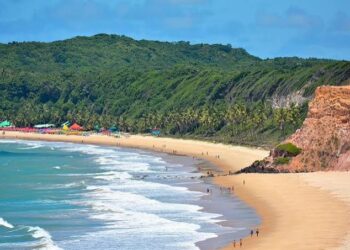

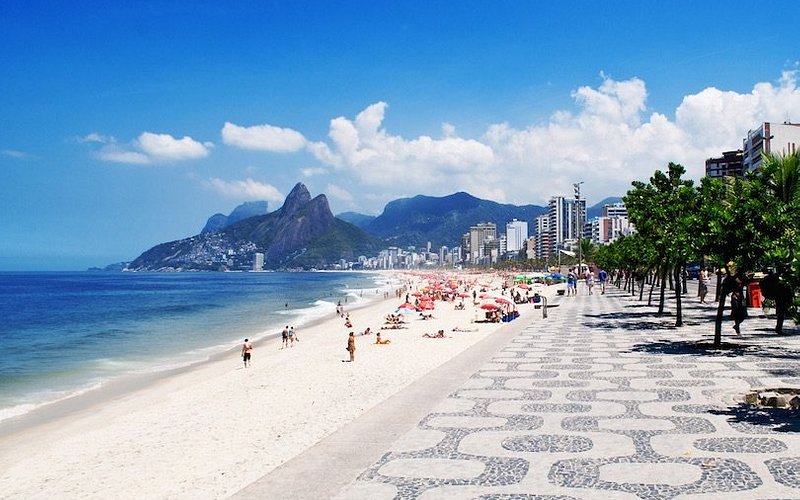
Ipanema Beach is located in the southern zone of Rio de Janeiro, extending for quite a distance of approximately 2.6km along the Atlantic coast. The area became widely recognised in part due to the song The Girl from Ipanema from the 1960s, which reflected aspects of the locality’s character, including its mix of natural setting and urban life.
In comparison with nearby Copacabana Beach, this beach is often associated with a somewhat more restrained and organised atmosphere. While Copacabana tends to attract larger volumes of visitors, Ipanema is generally perceived as more integrated with everyday city life, bordered by features such as Morro Dois Irmãos and the Arpoador.
The beach is used on a regular basis by both residents and visitors, not only for general recreation but also as a place where people tend to meet and spend time socially.
It may be considered suitable for a range of visitors, such as families, couples, as well as individuals who have interest in outdoor movement or in observing general day-to-day public activity. The environment consists of a sandy coastal stretch with some raised natural features nearby, and the level of activity is noticeable but not very intense, though it can vary at different times of the day and under changing conditions.
Best Time to Visit
A commonly preferred period extends from December to March, when the summer season brings higher temperatures and clear conditions suitable for spending time near the beach. Daytime heat may rise to comparatively high levels, sometimes reaching the upper 80s to low 90s Fahrenheit, and short rainfall in the afternoon can occur, though it often does not last long. This time also corresponds with increased visitor presence and a more festive environment, particularly around occasions such as Rio Carnival and New Year’s Eve.
Months falling between April and June, as well as September to November, are sometimes considered more moderate in terms of climate. Temperatures during the day are lower, usually within the 70s to 80s range, and the number of visitors tends to reduce. Humidity levels may also be lower, while sea conditions generally remain suitable for entry.
Crowd presence is often manageable during weekdays across most of the year, but it can increase during weekends. Early morning hours provide relatively quieter conditions, which may be used for walking or light activity. In the evening, the sunset viewed from Arpoador is often noted, as the sun moves behind the Dois Irmãos, creating a widely observed visual scene. Late afternoon conditions are sometimes regarded as balanced in terms of light, temperature, and general atmosphere, though this may not remain same every day.
What Makes This Beach Unique
The sand at Ipanema is generally fine in texture and appears light in colour, often described between pale golden and whitish shades, and it remains reasonably comfortable to walk on even under strong sunlight. The water tends to show a deeper blue tone rather than a lighter turquoise, and wave conditions are usually moderate to at times stronger, which may be more suitable for individuals with some experience, while still requiring caution in certain areas. Ocean movement here is not always calm, and features such as undertow or rip currents may be present, especially along particular stretches.
The natural setting is defined by the presence of Dois Irmãos in the background and the rocky formation of Arpoador, which separates the beach from Copacabana Beach. Sections of the promenade include palm trees and areas of vegetation, while the nearby urban edge introduces buildings and shaded walkways, though these do not fully dominate the coastal environment.
The shoreline is arranged into a number of informal sections, usually recognised by numbered lifeguard posts, where different groups of visitors tend to remain or gather. Some parts are more frequently used by families, while other stretches are associated with different social groups, which leads to a noticeable change in atmosphere along various portions of the beach.
This combination of the surrounding landscape, the nature of the sea conditions, and the distribution of people across these sections gives the place a character that is somewhat distinct within the city, though such patterns may not always remain exactly same at all times.
Things to Do
Swimming is commonly practiced, although it is generally advised to observe the flag indications at the lifeguard posts and remain within areas where supervision is present. Water-based activities are more noticeable near the Arpoador section, where surfing instruction is sometimes available for beginners as well as those with some prior experience. Photography is also frequently carried out, particularly during the later part of the day when lighting conditions change, capturing views of the sea and surrounding elevations. Walking along the approximate 2.6-kilometre stretch may be undertaken, offering continuous observation of public activity.
Recreational games such as volleyball and foot-based variants are regularly seen on the sand, contributing to the general sound and movement within the area. Along the promenade, small cafés and kiosk-type outlets are present, providing basic refreshments without requiring long movement away from the beachfront. In a broader sense, many visitors spend time observing the surroundings, including local residents engaged in walking, running, or other forms of movement along the patterned walkway, which forms part of the daily coastal routine.
Travel Tips & Safety
Lifeguards are generally stationed at the postos during most parts of the day, and sea conditions are monitored on a regular basis. Strong water movement, including currents and occasional rip tides, can be present, so it is generally advised to pay attention to warning flags and not to enter the water alone. Strong water movement, including currents and occasional rip tides, can be present, so it is generally advised to pay attention to warning flags and not to enter the water alone.