
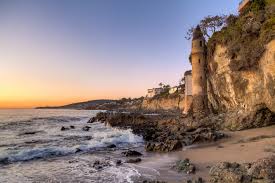
Victoria Beach is a small but visually striking coastal area located in Laguna Beach, within Orange County, California, United States, roughly 50 miles south of downtown Los Angeles along the Pacific coast. The shoreline is relatively short and includes sections of soft, light-colored sand mixed with rocky areas. Steep sea cliffs, exposed tide pools, and a well known stone structure commonly called the Pirate Tower give the beach a distinctive and slightly historic appearance. The ocean here usually has moderate wave action, and offshore rocks provide some natural shelter, which adds to the scenic quality and makes the area especially appealing for photography and slow exploration rather than active swimming.
Management of the beach falls under the City of Laguna Beach, working together with the California Coastal Commission, which is responsible for regulating public access, basic upkeep, and long-term coastal protection. Efforts include care of the tide pool zones and measures to reduce shoreline erosion, although conditions can change seasonally. Compared with the busier central beaches of Laguna, Victoria Beach tends to attract quite a fewer visitors. It is often preferred by local residents, photographers, and those interested in coastal details who look for a quieter setting. Its location close to Pacific Coast Highway also makes it an easy, if sometimes overlooked, stop for travelers moving along Southern California’s coastal route.
Fun Feature of Victoria Beach
Victoria Beach is particularly recognized for the structure commonly referred to as the Pirate Tower, a stone water tower rising to roughly sixty feet in height. It was constructed in 1926 by a private property owner and intentionally designed to resemble a medieval styled turret as it is being positioned directly on the sand, the tower is clearly visible from much of the shoreline and has become a defining visual element of the beach, often giving the area a storybook or slightly unreal appearance.
In addition to this feature, the southern end of Victoria Beach reveals notable natural formations during periods of low tide. A sea cave and a small rock arch can then be reached on foot, exposing layers of the coastal geology that are usually hidden when the tide is higher. These elements together contribute to the dramatic character of the cove and explain why the location is frequently photographed and documented, especially within Laguna Beach, despite its relatively limited size and quieter atmosphere.
Things to Do at Victoria Beach
Activities at Victoria Beach tend to be quiet in the nature and closely connected to the cove’s landscape and coastal formations. Many visitors focus on photography, particularly of the well-known Pirate Tower and the nearby rock arch. These subjects are most accessible during low tide, when the sea cave at the southern end of the beach can be reached without difficulty, although footing may still be uneven.
Tide pooling is another common activity, carried out around exposed rocks and along the edges of the cave when water levels recede. At these times, small marine species such as sea anemones, starfish, and hermit crabs can often be observed, provided they are not disturbed. Swimming or light wading may take place in calmer portions of the cove, though conditions change quickly and are not always suitable, especially close to submerged rocks.
Walking along the limited stretch of sand allows visitors to examine the cliffs and layered rock surfaces at a slow pace. Many people also remain seated on the sand or use portable chairs, as permanent facilities and shade structures are minimal, with some natural shelter only from the cliff base. Toward evening, the beach becomes a favored spot for sunset viewing, when shifting light reflects off the tower stonework and the surface of the ocean, creating noticeable changes in color and contrast.
Short walks on nearby coastal paths are sometimes included, offering slightly elevated views over the cove and the open Pacific beyond. Those wishing to extend their visit often travel a short distance to nearby points of interest, such as the Laguna Art Museum or Heisler Park, both of which provide additional scenery and walking areas along the coastline.
It should be noted that swimming is not consistently advised, as currents near the rock formations can be stronger than expected. Visitors are generally encouraged to observe posted notices and assess ocean conditions carefully before entering the water.
How to Get to Victoria Beach
Reaching Victoria Beach is possible mainly via the Pacific Coast Highway (Highway 1):
From Los Angeles: about 1 to 1.5 hours by car using I-405 south and then Highway 1, covering roughly 55 miles.
From John Wayne Airport (SNA): roughly 30 to 45 minutes by car heading south along Highway 1.
By bus: Some Orange County Transportation Authority (OCTA) lines stop near Coast Highway; from there, a short walk is needed to reach the beach.
Parking at Victoria Beach is really very limited. There is some street parking along Victoria Drive and nearby residential streets, but most spots have meters and time limits. The small lot at the top of the stairs leading down to the beach usually fills quickly, especially on weekends in summer.
Best Time to Visit
The best season to go depends on what you want to do. From June to September, the summer temperatures are around 70–78 °F (21–26 °C) and the ocean is warmer. This is quite a good time for photography, exploring tide pools and enjoying the cliffs, but expect more people on weekends.
From October to May, temperatures are milder, roughly 60–72 °F (15–22 °C), and humidity is lower. These months are better for walking along the sand, looking at rock formations, and having a quieter experience. Sometimes there is a morning fog from the marine layer, but it usually goes away by midday, leaving comfortable weather for visitors.