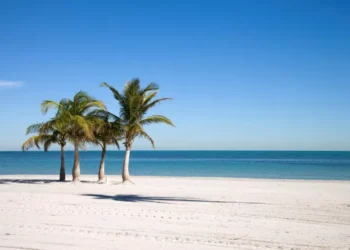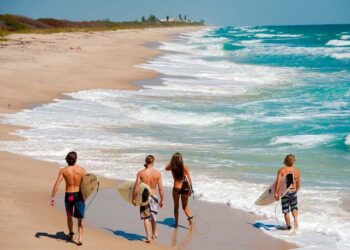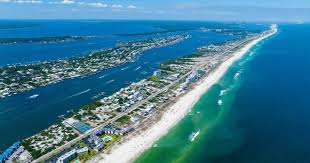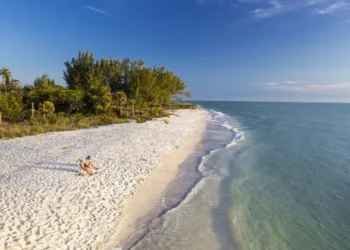

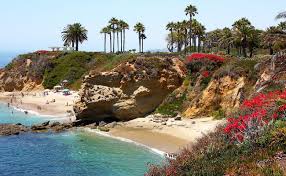
Treasure Island Beach is a small, pretty coastal cove in Laguna Beach, Orange County, California, United States, around 50 miles south from downtown Los Angeles along the Pacific Ocean. The beach is only about 200 meters long, made of soft golden sand, and sits between rocky headlands. There is a big offshore rock in the middle of the cove that makes it look dramatic. The beach faces the Pacific Ocean and gets moderate waves, but the cliffs around it shelter the central part, so swimming there is calmer than at nearby exposed beaches. The City of Laguna Beach manages the beach together with the California Coastal Commission, which takes care of public access, cleaning, and protecting the tide pools and coastline from erosion. Photographers, tide pool watchers, and locals who want a quieter beach come here, because it is less crowded than central Laguna Beach. Its position near Pacific Coast Highway also makes it easy for travelers to stop by when exploring the Southern California coast.
Unique Feature of Treasure Island Beach
Treasure Island Beach is notable for the large, solitary rock that sits offshore near the center of the cove, forming a very visible landmark and acting like a natural break for the waves. This rock, together with the nearby tide pools and the stairs coming down from the cliffs, makes the beach a very good place to see marine life and take photographs. At low tide, the pools show many sea creatures, giving especially rich chances to explore the local marine life.
Things to Do at Treasure Island Beach
Treasure Island Beach offers several relaxing and exploratory activities that suit its scenic and the rocky landscape:
Visitors can swim or wade in the calmer central part of the cove when the ocean conditions are quite safe. Tide pooling around the rocky edges and at the base of the offshore rock is popular during low tide, where anemones, starfish, hermit crabs, and other small marine creatures can be seen.
Walking along the short stretch of sand and exploring around the rock formation allows for quiet beach strolls. Photography is a favored activity, particularly of the offshore rock and surrounding cliffs, with sunrise and sunset providing especially striking light.
People can relax on the sand or bring portable chairs, though shade is limited to spots near the cliffs. Short hikes on nearby coastal trails give elevated views of the cove and the Pacific horizon.
Visitors can combine their beach trip with the nearby attractions like the Heisler Park or the Laguna Art Museum to enjoy more of local coastal scenery.
Swimming near the rocks is sometimes bit risky because of strong currents, it is important to check conditions and follow the posted warnings before entering the water.
How to Reach Treasure Island Beach
Treasure Island Beach is accessed primarily from Pacific Coast Highway, which runs then directly along the coastline.
From Los Angeles, the drive generally takes between one and one and a half hours, depending on traffic conditions. The usual route follows Interstate 405 south before connecting with Highway 1, covering a distance of roughly fifty-five miles.
Travelers arriving via John Wayne Airport can expect a driving time of about thirty to forty-five minutes by following Highway 1 south toward Laguna Beach.
Public transportation is possible, as Orange County Transportation Authority bus routes operate along the Coast Highway. From the nearest stop, the visitors must walk a short distance to reach the beach access stairs.
Parking options are limited. Most visitors rely on street parking along Cliff Drive or the nearby residential roads, where the spaces are metered and subject to time restrictions.
Optimal Periods for Visitation
June to September constitutes the peak summer season, with temperatures of 70–78 °F (21–26 °C), warmer ocean water, and higher visitor numbers; ideal for tide pooling and photography but expect crowds on weekends.October to May offers milder temperatures (60–72 °F / 15–22 °C) and lower humidity, suitable for walking, exploration, and less crowded beach time, though occasional marine layer fog may occur.
Practical Notes for Visitors
Before arriving at Treasure Island Beach, it is advisable to consult local tide tables. Access to the most active tide pools and the area close to the offshore rock depends largely on low tide conditions, which change daily.
Street parking in the surrounding area operates on a metered and time-restricted basis. Both cash and card payment are generally accepted, though availability of spaces can vary and patience is sometimes required.
Because of the open coastal setting, sun exposure can be strong even on mild days. Use of high-SPF sunscreen, along with a hat and sunglasses, is strongly recommended, as light reflects off both sand and water.
Ocean conditions near the rock formations may be quite unpredictable. Currents can become strong without much warning, therefore swimming should be limited to the calmer central part of the cove and only when conditions appear safe. Posted notices should not be ignored.
There are no accommodation facilities directly adjacent to the beach. Most visitors choose to stay in hotels or licensed rentals within Laguna Beach, where nightly rates commonly range between two hundred and five hundred US dollars, depending on season.
Environmental rules are enforced within the area. Littering is not permitted, and visitors are encouraged to use reef-safe sunscreen in order to reduce impact on marine life.
The beach is considered suitable for daytime visits. Still, personal belongings should be secured inside vehicles, and lingering in poorly lit areas near dusk is generally best avoided.