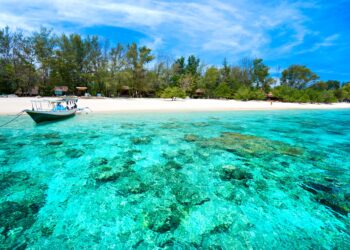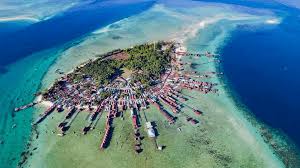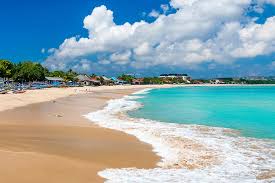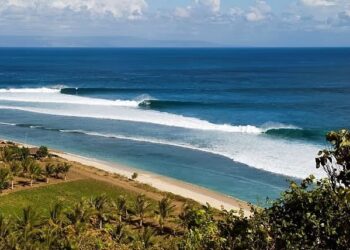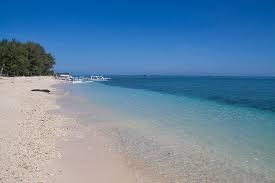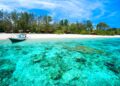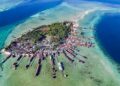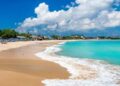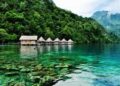

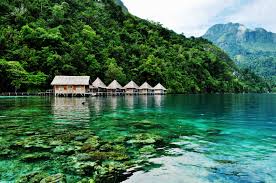
Ora Beach is a remote shoreline located on the northern coast of Seram Island, within Central Maluku Regency, Maluku Province, Indonesia, about 500 kilometers northeast of Ambon and roughly 2,500 kilometers east of Jakarta. The beach extends for around one kilometer, with fine white coral sand curving gently along the bay and bordered by hills densely covered in rainforest. It faces the calm, turquoise waters of Teluk Sawai, with shallow lagoons sheltered by offshore reefs, making the area good for snorkeling and keeping wave activity low. Ora Beach lies within the buffer zone of Manusela National Park and is managed by the Central Maluku Regency Tourism Office together with the Indonesian Ministry of Tourism and Creative Economy, which encourages sustainable tourism, marine protection, and controlled visitor access.
Fun Fact About Ora Beach
Ora Beach is known for its shallow bay, which acts like a natural aquarium, showing colorful coral gardens and schools of fish visible from above the water. It became known internationally after appearing in Indonesian tourism promotions as “Indonesia’s Little Raja Ampat,” because of its karst hills and rich marine life, but it sees far fewer visitors, often only a few people at a time.
History of Ora Beach
The coastline of Seram Island, including Ora Beach, has long been home to indigenous Maluku communities who depended on the bay for fishing, gathering, and trade between islands. The name “Ora” comes from the local language and means “bay” or “cove,” a reference to the beach’s natural shelter.
During the Dutch colonial era (1621–1945), Seram was known for spice production, but Ora itself remained mostly isolated because of the difficult terrain. In World War II (1942–1945), the Japanese used nearby bays for supply purposes, yet the beach saw little direct activity. After Indonesia gained independence, local communities mainly focused on small-scale fishing and copra production.
Tourism began slowly in the 1990s, largely thanks to Ambon acting as a gateway, but Ora remained largely unnoticed until the 2010s, when better boat connections and social media brought attention to its natural beauty. More recently, the Maluku government has promoted low-impact development to maintain the beach’s ecosystem while supporting eastern Indonesia’s tourism growth.
Things to Do at Ora Beach
Ora Beach offers a small range of nature-focused activities that fit its quiet, protected setting:
Snorkeling in the shallow lagoons and nearby reefs, where sea turtles, clownfish, and colorful coral can often be seen. Resorts usually provide basic equipment.
Swimming in the calm, clear waters of the bay, which is safe for visitors of all ages due to gentle slopes and reef protection.
Relaxing or sunbathing on the largely empty beach, with some natural shade from palm trees and cliffs.
Kayaking or using a stand-up paddleboard to explore the bay or nearby mangrove channels, with gear available from eco-resorts.
Short hikes to viewpoints on the hills surrounding the bay, giving panoramic views of the coastline and distant islands, usually taking about 20–30 minutes.
Small boat trips to nearby Sawai village or Ohoiew mangrove forest, where visitors can do some birdwatching and learn local culture.
How to Get to Ora Beach
Reaching Ora Beach usually involves several steps because of its remote location on Seram Island:
From Jakarta: Take a domestic flight to Ambon Airport (Pattimura), which takes around 3–4 hours. From Ambon, travelers can continue by either a short domestic flight or a ferry to Masohi, Seram’s main town, flight takes roughly 1–2 hours, ferry about 4–6 hours, costing between IDR 200,000 and 500,000. From Masohi, a van ride to Saleman village takes around 2–3 hours, with fares commonly between IDR 300,000 and 500,000. From Saleman, a small boat or speedboat carries visitors to Ora Beach in about 15–20 minutes (IDR 50,000–100,000).
From Makassar: Fly to Ambon (about 1.5 hours), then follow the same onward route as above.
At Saleman village: Local boats or speedboats are used, with costs depending on group size (IDR 50,000–200,000). Once at the island, the beach is only a short walk from the landing; there are no motor vehicles.
Best Time to Visit
Best times to visit are between April and October, when the weather is generally dry with temperatures around 28–32 °C and good underwater visibility for snorkeling. Peak visitor numbers occur during June–August. Between November and March, rainfall increases, but fewer tourists are present; mornings are often still clear for beach activities.
Practical Recommendations
Travelers should plan ahead for boats and places to stay, particularly during the busy months of April to October, because options are few. Cash in Indonesian rupiah is also quite needed as there is no ATM on the island. It is quite advisable to bring strong sun protection like SPF 50+ cream, hats, and rash guards because the sun is very strong.
Snorkel and dive gear is normally given by the small eco-resorts, but any personal equipment must be cleaned first to avoid bringing unwanted species. Staying options are limited to simple homestays or eco-resorts, usually costing about IDR 500,000 to 1,500,000 per night, sometimes with meals included.
Visitors should follow the environmental rules: do not touch corals, do not feed fish or turtles, and do not leave trash. Any fees collected go to support local conservation. Boat trips can be affected by weather, so it is better to check the schedule a day before traveling.