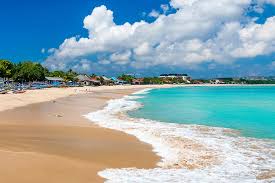

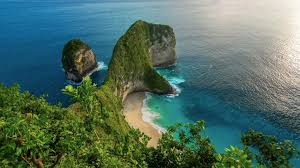
Kelingking Beach is located on the south-western side of Nusa Penida Island in Bali Province, Indonesia, and is often regarded as one of the island’s more visually prominent coastal sites, noted mainly for its dramatic natural setting rather than for beach facilities. The beach itself consists of a short, confined strip of pale sand with clear blue-green waters, situated at the base of a high limestone cliff that drops steeply and almost directly into the sea. When viewed from above, the cliff formation loosely resembles the shape of a dinosaur’s head and spine, a visual association that over time has led visitors to refer to the area as “T-Rex Beach,” although this description is informal and not officially recognised.
The clifftop viewpoint remains the primary point of interest for most visitors, as access to the beach below requires descending a steep and narrow footpath. This trail is uneven in several sections and is fitted only with simple bamboo handrails, making the descent physically demanding and sometimes unsafe during rain or strong wind. Administratively, the site lies within Nusa Penida District under Klungkung Regency and is overseen through cooperation between local village authorities and provincial tourism offices.
Due to the terrain and limited space, visitor flow is managed in a loose and informal manner by local operators and residents, mainly to reduce crowding and prevent accidents. For this reason, Kelingking Beach is generally visited by photographers, individual travellers, and day visitors from mainland Bali, many of whom come primarily to observe and document the area’s striking natural formation and its comparatively isolated setting.
Distinctive Feature of Kelingking Beach
A principal characteristic of Kelingking Beach is the massive limestone headland that projects outward toward the Indian Ocean, forming a cliff shape widely associated with the outline of a dinosaur. Access to the shoreline is made by a very steep and narrow footpath, estimated at several hundred steps, cut directly into the rock face. The route is exposed in many sections and allows wide, elevated views over the small cove and the strong surf below, which for many visitors becomes the main visual experience rather than the beach itself.
Activities Available at Kelingking Beach
Kelingking Beach functions mainly as a scenic lookout and nature observation area, with activities shaped by the site’s steep terrain and safety limitations. Going down to the actual beach is less important than the view from the cliff. Most people spend their time at the top, looking at the full shape of the limestone cliff, the small strip of sand below, and the wide ocean beyond, often taking photos. This viewpoint is considered the main attraction and is accessible to most visitors without descending.
For those in good physical condition, it is possible to walk down to the beach using the narrow and steep footpath carved into the cliff. The descent usually takes a significant amount of time and effort, and the return climb is demanding. The trail is exposed, uneven, and not recommended during wet conditions or for individuals with mobility concerns.
At beach level, tourists can spend short periods resting on the sand or entering the water when sea conditions are calm. Swimming is possible only with caution, as strong currents and waves are common, and there are no lifeguard services present.
Limited snorkeling may be done near the rocky edges of the cove during favorable conditions, although this is not a primary snorkeling destination. Marine life sightings are occasional and depend heavily on tides and visibility.
Kelingking Beach is usually approached as one location within structured travel circuits around Nusa Penida, where it is visited alongside coastal formations such as Broken Beach and Angel’s Billabong. In these situations, the stay at Kelingking tends to be short in length, with most visitors concentrating on viewing the landscape and taking photographs, rather than spending long periods on rest or other recreational use.
Access to Kelingking Beach
Access to Kelingking Beach involves several steps from Bali:
Take a fast boat from Sanur or Padang Bai to Nusa Penida, arriving at Toyapakeh or Buyuk harbour, which usually takes around 30–45 minutes.
From the harbour, travel by rented motorbike or private driver along paved but winding roads for about 45–60 minutes to reach the Kelingking viewpoint car park.
Finally, a short walk of 5–10 minutes from the car park leads to the cliff-top viewpoint.
Best time to visit Kelingking Beach
The best time to visit Kelingking Beach is generally from May to September, which is considered the dry season. During this period, the sky usually clear and the sea calm, with temperatures around 27–31 °C, making it easier for photography and descending the trail to the beach.
Between October and April, the wet season usually brings heavier rainfall and occasionally rough seas, making boat travel harder, but the lower number of visitors makes the beach calmer and more peaceful.