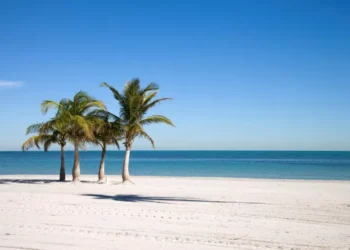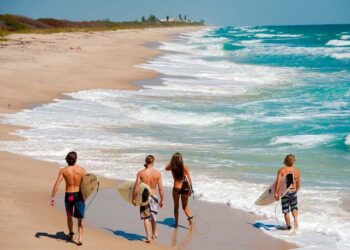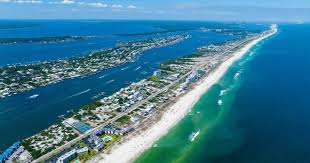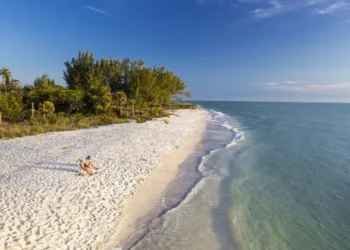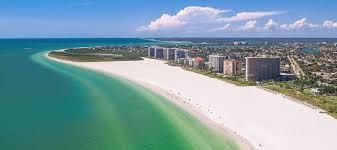

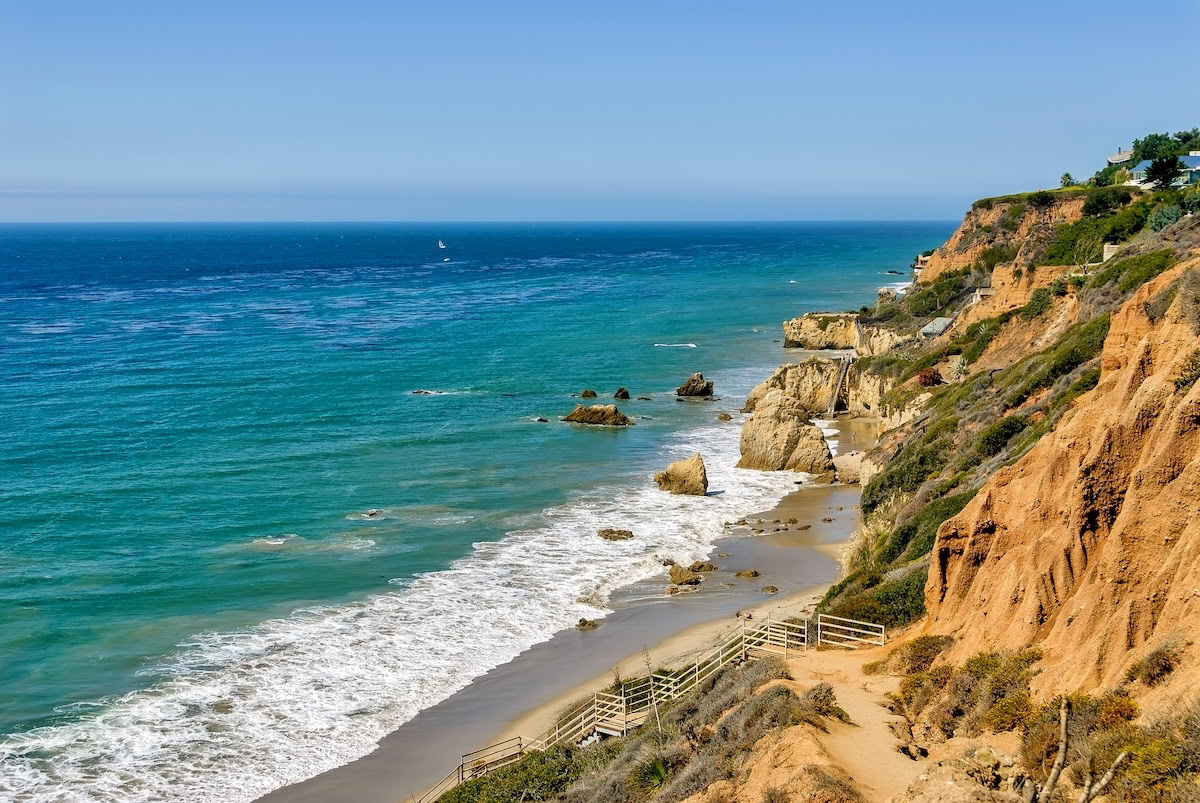
El Matador State Beach lies along the Malibu coast in Los Angeles County, California, at a distance of roughly twenty-five miles to the west of Santa Monica, beside the Pacific Coast Highway. The shoreline here is not extensive, extending for about half a mile only, and is composed mainly of pale golden sand interrupted by rocky outcrops. Large sea stacks, narrow sea caves, and uneven headlands shape the coastline and give the beach a distinctly rugged form rather than a wide, open strand.
The beach opens directly toward the Pacific Ocean, where wave activity can be moderate to strong at times, while steep coastal bluffs rise immediately behind the sand. These slopes are largely covered with native coastal vegetation and remain mostly undeveloped. Management of the area falls under California State Parks, as part of the Malibu Coast park holdings, with duties that include regulating access, maintaining footpaths, and safeguarding natural features such as tide pools and unstable cliff edges.
Because parking is limited and the beach itself is relatively small, visitor numbers are usually lower than at the broader beaches closer to Santa Monica or Venice. As a result, the area is often chosen by photographers, walkers and visitors looking for a quieter coastal setting. Its roadside position along Highway 1 allows easy access for travelers, yet the controlled facilities have helped the beach keep much of its natural and undeveloped character.
Unique Feature of El Matador State Beach
El Matador State Beach is mainly recognized for the unusual rock formations that stand along and just offshore from the shoreline. Over the long period, wave action has shaped these rocks into sea stacks, arches, and narrow openings, giving the beach a dramatic appearance that feels quite distinct from nearby stretches of coast. One large, detached rock close to the waterline is especially notable, as its shape suggests a natural arch and it often becomes strongly highlighted during the late afternoon and sunset hours.
During low tide, sections of the rocky shore expose small tide pools that support various forms of marine life. These pools, together with the eroded stone formations, make the beach an important spot in Malibu for observing coastal features and for photography, particularly when light and tide conditions are favorable.
Things to Do at El Matador State Beach
El Matador State Beach offers a range of quiet and exploratory activities that match its rocky and undeveloped coastal character. The shoreline is frequently used for photographic purposes, mainly focusing on the sea stacks, weather-worn arches, and the steep cliff faces that border the beach. Early morning and later evening periods are generally favored, since the angle of the sunlight shifts noticeably at these times, producing deeper shadows and uneven contrasts across the rock surfaces, which many observers consider visually appealing, though the light can change quite quickly.
During the low tides, the sections of the exposed rock become accessible and allow for the observation of tide pools. These shallow pools often contain small marine forms such as anemones, starfish, hermit crabs and other organisms adapted to this environment. The setting encourages slow movement and careful attention rather than active use of the shoreline. Walking is also common along the narrow band of sand, particularly near the base of the rock formations, where the terrain alters over short distances and gives a varied sense of scale and texture.
Short walks can be taken on nearby coastal paths above the beach, providing elevated views of the cove and open Pacific Ocean. Many visitors choose simply to sit or rest on the sand or on portable chairs, though shade is limited and depends largely on the position of the cliffs during the day. Marine mammals such as seals or sea lions may occasionally be seen offshore, particularly during calmer conditions.
Picnicking is permitted only in designated areas near the parking access, and open fires are not allowed. Sunset viewing is also among the most popular activities, whether from the sand itself or from the lower cliff edges as setting sun often highlights the rock formations in warm tones. Swimming is quite generally discouraged because of strong currents and wave action, and the beach is better suited for observation, walking, and photography rather than water-based activities.
How to Get to El Matador State Beach
Access to El Matador State Beach is generally made by way of the Pacific Coast Highway. Travelers coming from Los Angeles usually reach the area by driving south on Interstate 405 and then continuing along Highway 1, a journey that often takes between one hour and one and a half hours, depending on traffic, for a distance of roughly thirty-five miles.
Those arriving from John Wayne Airport typically follow Highway 1 south, with travel time close to one hour under normal conditions. Public transportation options are limited; some Los Angeles Metro or Malibu Transit bus routes stop along the Coast Highway, after which a short walk or taxi ride is needed to reach the access point.
Parking is provided in a small lot located above the stairway leading down to the beach. A daily fee, usually around twelve US dollars, is charged, and both cash and card are accepted. During busier months, especially in summer, this parking area often fills earlier in the day, sometimes before mid-morning.
Best Time to Visit
The period from March through May, as well as the months between September and November, is generally considered the most favorable time to visit. During these seasons, temperatures are usually moderate, ranging from about 55 to 70 °F (13–21 °C), and visitor numbers remain relatively lower. These conditions are often suitable for photography and for observing tide pools, as visibility is commonly good.
The summer months, from June to August, represent the busiest part of the year. Temperatures tend to be warmer, often between 65 and 75 °F (18–24 °C), however the beach experiences a noticeable increase in visitors. At times, a marine layer may develop, particularly in the mornings, which can reduce visibility for several hours.