
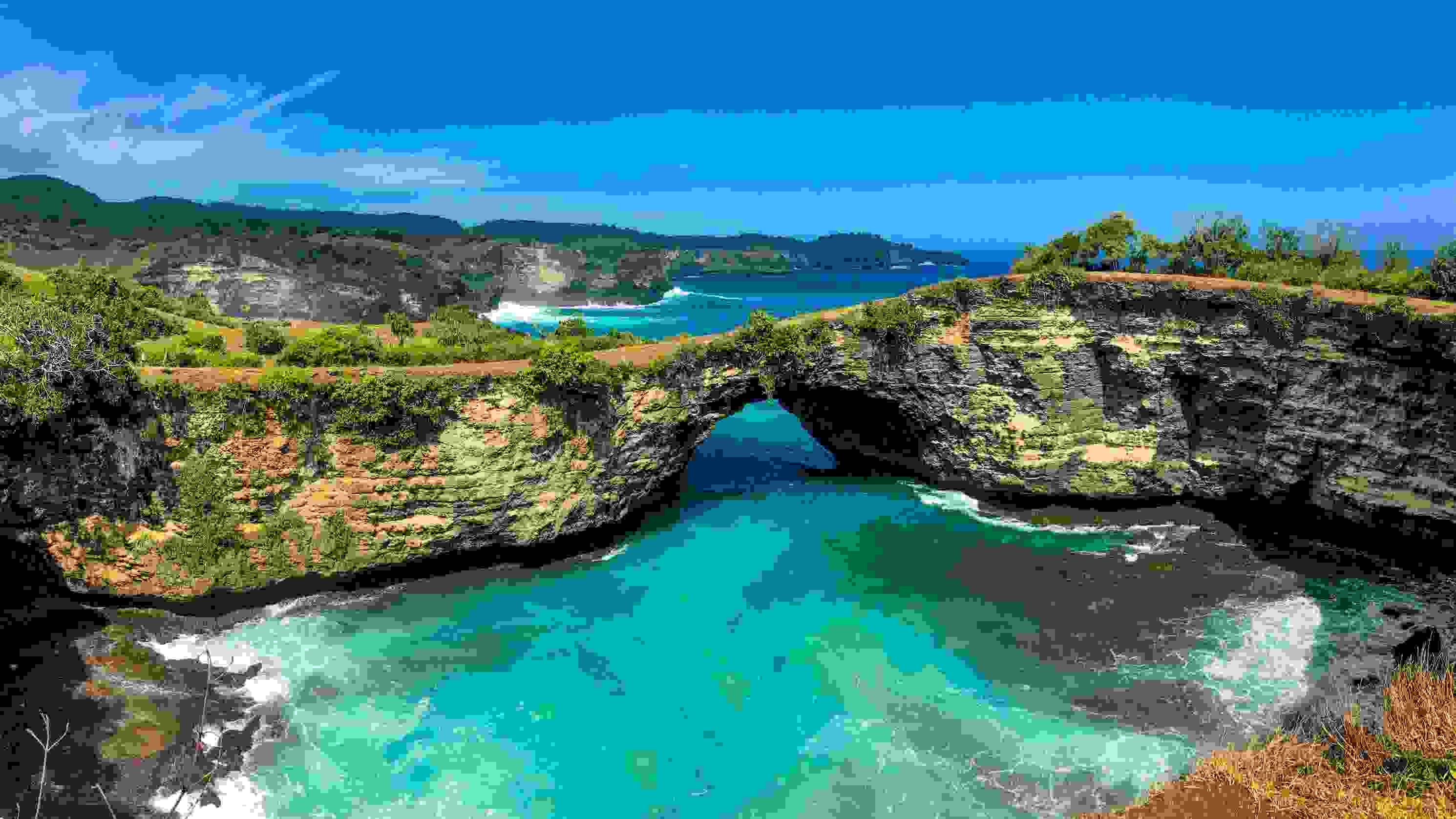
Broken Beach, known to local residents as Pasih Uug, is a striking coastal formation located along the south-western cliff edge of Nusa Penida Island in Bali Province, Indonesia. The area is formed by a large circular hollow in the limestone, measuring roughly fifty metres across, where part of the roof has collapsed over time. This natural collapse has created a natural arch that allows seawater from the Indian Ocean to flow into the enclosed space, forming a calm pool within the opening.
The cliffs surrounding the site rise to an estimated height of eighty to one hundred metres and provide natural viewpoints from which the full shape of the arch can be seen. From these elevated areas, visitors are able to observe the beautiful contrast between the dark blue ocean water and the pale, rugged limestone walls. Broken Beach lies within the Nusa Penida District under Klungkung Regency, with oversight shared between the Bali Provincial Tourism authorities and local village management.
Entry to the beach is controlled through a viewing area, where a small access fee is usually required. The location is commonly included in organised day tours of Nusa Penida and is promoted as one of the island’s notable natural landmarks. Interest in Broken Beach mainly comes from its unusual geological structure, the wide views available from the cliff tops, and its setting, which remains quieter when compared with many tourist sites on mainland Bali.
Unique Feature of Broken Beach
The most notable element of Broken Beach is the large natural arch that was created after the roof of a limestone cavern gave way. This collapse resulted in a rounded opening that directly faces the sea, allowing a clear view of the ocean through the rock formation. The width of the arch is estimated to be between twenty and thirty metres, and the enclosed water area below is linked to the open sea by a narrow passage.
As waves move in and out through this channel, a noticeable echoing sound is produced within the hollow space. Because of its unusual structure and dramatic appearance, this formation has become one of the most frequently photographed sites on Nusa Penida. It is also commonly included in visitor routes together with the nearby Angel’s Billabong, which lies a short distance away and is often visited on the same tour.
Historical Context and Exposure of Broken Beach
The limestone formations found along the coast of Nusa Penida, including the area known as Broken Beach, developed over very long geological periods as a result of tectonic movement and continuous erosion by the sea. The arch seen today is believed to be much newer in comparison, which was formed when the roof of a sea cave collapsed after prolonged exposure to wave pressure and natural weathering, possibly within the last few thousand years.
For local Balinese communities, this part of the island has traditionally been viewed as a wider sacred landscape with presence of small temples and shrines in nearby areas reflecting this cultural and spiritual importance. For many years, up until the early part of the 2010s, Broken Beach was not widely promoted and remained known mainly to residents of the island, fishermen, and a small number of visitors from Bali.
Greater attention began around the period between 2015 and 2017, when aerial photographs and images shared online brought the site to wider public notice. This sudden exposure led to a rapid increase in visitor numbers and established Broken Beach as one of the well-known natural feature of Indonesia. In response to this growth, local village authorities together with Klungkung Regency introduced organised viewing areas, safety barriers, and a system of entry fees during 2018 and 2019.
Activities Available at Broken Beach
Broken Beach is used mainly as a viewing location rather than a place for water activities, due to the high cliffs and the absence of safe access to the sea below. Most visitor activity takes place from elevated ground overlooking the formation.
Visitors typically spend time at the main cliff-top viewing area, which has been set aside for observation and photography. From this point, the full shape of the natural arch and the enclosed water below can be seen preety clearly. Short walking paths lead to additional viewpoints nearby, allowing the formation to be viewed from slightly different positions.
Many people also observe the movement of the waves and changes in tide within the hollow section of the rock. During high tide, the sea enters more forcefully through the narrow opening, and the water level inside the cavern rises noticeably, which is often of interest to visitors.
Broken Beach is commonly included in organised day tours of Nusa Penida. These tours usually combine the site with nearby locations such as Angel’s Billabong, Kelingking Beach, and other coastal viewpoints on the island.
Swimming and direct access to the water are not allowed and are not practical, as the cliffs drop vertically to the sea and strong currents are present in the area below.
Best Time to Visit
In between the months of May and September, conditions are generally drier compared to the rest of the year. The weather is often more predictable, skies remain clearer for longer periods, and the sea is usually less rough, with temperatures staying around 27–31 °C. These conditions tend to make the site easier to view, as the arch and the enclosed water can be seen more clearly under stable light.
From October through April, the region experiences the wet season. Rainfall is more frequent, and sea conditions can become less predictable, which may sometimes affect boat travel. However, visitor numbers are typically lower during this period, and some travellers prefer this time for a quieter atmosphere, even though weather conditions may vary.