
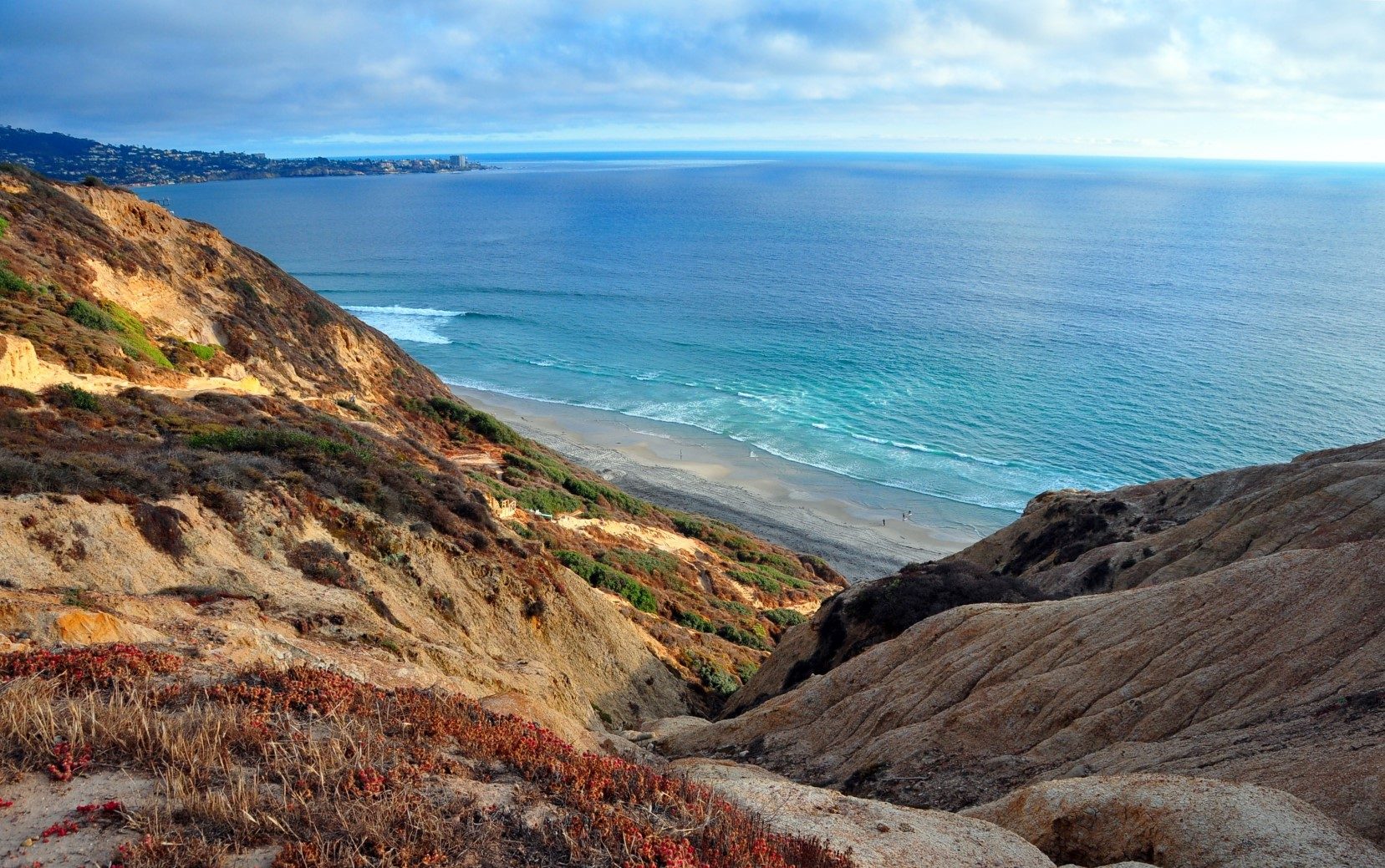
Black’s Beach is located along the shoreline of La Jolla, California, set quite directly below the high coastal bluffs near the Torrey Pines area. The beach extends for almost two miles in length and is formed largely of pale, fine-grained sand facing the open Pacific Ocean. Ocean conditions are frequently rough, with strong wave energy and a sharply sloping seabed, factors that give the beach a more severe and visually imposing character.
Rising immediately behind the shore are tall sandstone cliffs, in places approaching three hundred feet, which create a marked separation from the surrounding developed areas. Because of these cliffs and the limited access routes, the beach retains a sense of remoteness, even though it lies within the broader San Diego coastal region. The land above forms part of the Torrey Pines State Natural Reserve and adjoining coastal park areas managed by the City of San Diego. Oversight is shared with California State Parks, with responsibilities covering access control, visitor safety and protection of sensitive coastal and marine environments.
The northern portion of the beach is widely recognized for its long-standing clothing-optional use, while the exposed breaks offshore have earned the area a reputation among experienced surfers. Because access routes are steep and physically demanding, visitor numbers tend to be lower than at more developed beaches elsewhere in San Diego. These same factors have helped maintain the beach’s largely undeveloped and natural condition, even as urban areas remain close by.
Unique Feature of Black’s Beach
Black’s Beach is particularly known for the clothing-optional practice permitted along its northern stretch, which has existed for many decades and is considered among the most established of its kind in the United States. This aspect, together with the beach’s physical separation, has long contributed to its distinct identity.
Another defining element is the line of steep sandstone cliffs rising to nearly three hundred feet above the shore. Access to the beach from the bluff tops is gained mainly by a narrow and demanding trail descending from the Torrey Pines Gliderport. From these elevated edges, wide coastal views are available, and the bluffs are frequently used for paragliding and hang gliding, activities that have become closely associated with the area.
Things to Do at Black’s Beach
Black’s Beach allows for several outdoor pursuits that reflect its exposed and rugged coastal character. The beach is widely used for surfing, as wave conditions are strong and regular, though the presence of rip currents means this activity is more appropriate for experienced surfers rather than casual swimmers.
Access to the shoreline is commonly made by descending the steep trail from the Torrey Pines Gliderport, a walk that requires some physical effort, especially on the return climb. Once on the beach, visitors often spend time resting or sunbathing on the broad sand, with the northern section traditionally remaining clothing-optional.
The cliffs above the beach are well known for paragliding and hang gliding, and observers frequently gather near the gliderport to watch these flights along the bluff edge. During periods of low tide, limited tide pooling may be found near the rocky edges, where small marine species such as anemones or hermit crabs can sometimes be seen.
Walking along the shoreline is another common activity, particularly toward the northern end where the sand gradually connects with Torrey Pines State Beach. In calmer moments, visitors may also notice harbor seals or sea lions moving through the nearshore waters. Informal picnicking occurs near the base of the cliffs, although fires are not permitted anywhere on the beach.
Swimming is generally discouraged for inexperienced visitors, as surf conditions can change quickly and currents are often strong. Posted advisories and local conditions should always be taken into account before entering the water.
How to Get to Black’s Beach
Access to Black’s Beach is generally made through the Torrey Pines area rather than by direct coastal road. Travelers arriving from San Diego International Airport typically reach the area in about twenty to thirty minutes by car, using Interstate 5 northbound and exiting toward Torrey Pines Road, the total distance being roughly twelve miles.
Those coming from central San Diego follow a similar route on Interstate 5 north, with travel times varying between twenty-five and forty minutes depending on traffic conditions. Public transportation is possible but less direct; San Diego Metropolitan Transit System bus routes 101 or 30 serve stops near Torrey Pines, after which a short walk or local taxi ride is usually required.
Final access to the shoreline is made on foot. From the parking area at the Torrey Pines Gliderport, visitors must descend the steep Gliderport Trail, as no road leads directly to the beach itself. The path can be demanding, especially on the return ascent.
Parking is available at the gliderport lot for a daily fee, generally ranging between ten and fifteen U.S. dollars, while limited street parking may also be found along Torrey Pines Road, subject to posted time restrictions.
Best Time to Visit
The best time to visit Black’s Beach depends on what kind of experience is preferred. From June through September, summer is at its peak. Temperatures usually range between 70 and 78 °F (21–26 °C), the ocean water is warmer, and more visitors come to the beach. This period is suitable for sunbathing, photography, and enjoying the dramatic coastal scenery, but weekends can be quite crowded.
Between October and May, the weather is usually milder, with temperatures around 60 to 72 °F (15–22 °C) and humidity lower than summer months. This time is more good for hiking on the cliffs, exploring tide pools, and spending time on the beach when it is not so crowded. In mornings, sometimes a marine layer fog comes, but it mostly goes away by midday, leaving the beach comfortable for visitors.